

Last Updated: October 28, 2026
Quick Summary
To buy coffee for construction sites, survey your crew on shift start, shift length and roast preference, then plan 1.5 cups per worker per 8-hour shift and add a buffer. Match the format to your site: bulk ground for large crews, pods for crews of 10 or fewer, and instant where there is no power for a brewer. Keep a sealed one-week backup supply and reorder when stock hits 20% of your weekly supply.
- A 10-person crew usually needs 20 to 30 cups across a full day.
- Add 0.5 cups per worker in cold weather or on night shifts.
- Pods work best for crews of 10 or fewer or when labor time is tight.
- Set a reorder threshold at 20% of your weekly supply.
- Store coffee in an airtight container away from direct sun and moisture.
Table of Contents
- Start With the Crew: Matching Coffee to Shift Length and Taste
- How Much Coffee for a Crew: Quantity and Cost Estimates
- Choosing a Coffee Maker for Construction Site Conditions
- Bulk Coffee for Construction Sites: Supplier and Packaging Options
- Coffee Supplies for Construction Crews: The Full Checklist
- Storage and Freshness in Changing Site Conditions
- Build Your Site Coffee Order With Blacktop Life Coffee Co.
- Frequently Asked Questions
Start With the Crew: Matching Coffee to Shift Length and Taste
Buying coffee for a construction crew starts with the people drinking it, not the supplier catalog. A 6 a.m. pour before a 10-hour shift calls for a different brew than a 2 p.m. pick-me-up, and the strongest roast on the shelf is wasted on a crew that wants something smooth. The best site coffee is the one workers actually finish their cup of.
Survey the Crew Before You Buy
Ask three questions before you spend a dollar:
- When does the shift start? Early crews tend to want a stronger, darker brew.
- How long is the shift? Longer shifts need a steady supply, not one big pot.
- What do they actually drink? Light, medium, or dark. Regular or decaf.
A quick show of hands on the first morning saves a month of wasted coffee. If you want to understand caffeine timing across a shift, this guide on 8 habits for healthy coffee energy without jitters breaks it down.
How Much Coffee for a Crew: Quantity and Cost Estimates
How much coffee for a crew comes down to a simple formula: plan for one to two cups per worker per shift, then add a buffer for the crew that drinks more. A 10-person crew usually needs 20 to 30 cups across a full day. But construction sites have variables that office coffee guides ignore, shift length, weather, and whether the crew is pouring from a thermos or making fresh pots all day.
A Construction-Specific Consumption Framework
Start with a baseline of 1.5 cups per worker per 8-hour shift. Adjust upward for these conditions:
- Cold weather or night shifts: Add 0.5 cups per worker, hot drinks go faster when temperatures drop.
- Long shifts (10-12 hours): Add 0.5-1 cup per worker for each additional 2 hours beyond 8.
- High-turnover crews or multiple trades on site: Add 20% buffer, you will have visitors and subcontractors who grab a cup.
- Thermos vs. fresh pot: Thermos users tend to drink less because the coffee stays hot longer; fresh-pot sites see faster consumption.
One option is to designate a person to track the daily count for the first week. That data can help you adjust your estimate.
Quantity and Cost Planning Table
Use this as a starting point, then adjust with the framework above:
| Crew Size | Cups Per Shift (baseline) | Ground Coffee Needed | Best Format | Approx. Cost Per Cup* |
|---|---|---|---|---|
| 5 workers | 8-12 cups | About 1/2 lb | 5-cup brewer or instant | Low |
| 10 workers | 15-25 cups | About 1 lb | 12-cup programmable brewer | Low-moderate |
| 20+ workers | 30-50 cups | About 2 lb | Large brewer plus thermoses | Moderate |
Cost per cup varies by supplier and format; bulk ground coffee and instant are typically the lowest cost per serving, while pods carry a convenience premium.
Reorder Thresholds and Backup Supply
A construction site cannot afford to run out mid-shift. Set a reorder threshold at 20% of your weekly supply. For a 10-person crew using 1 lb per day, that means ordering when you have 1.5 lb left, enough for a full day plus a buffer. Keep a separate sealed backup of at least one week's supply, stored away from the daily stock. When the main bag hits the threshold, the backup buys you time to reorder without a coffee-less morning.
Budgeting for the Full Site Coffee Setup
Beyond the coffee, consider what supplies your site needs. A practical approach is to calculate a per-worker per-week budget, then compare it against supplier quotes. The right balance depends on your crew size and how much labor you want to spend on coffee setup each morning.
Choosing a Coffee Maker for Construction Site Conditions
When choosing a coffee maker for a construction site, consider the conditions where it will be used.
Look for these traits:
- Simple controls that work with gloves on
- A sturdy carafe or thermal design that won't shatter
- Easy cleanup with few moving parts
- Low power draw that works off a generator or site power
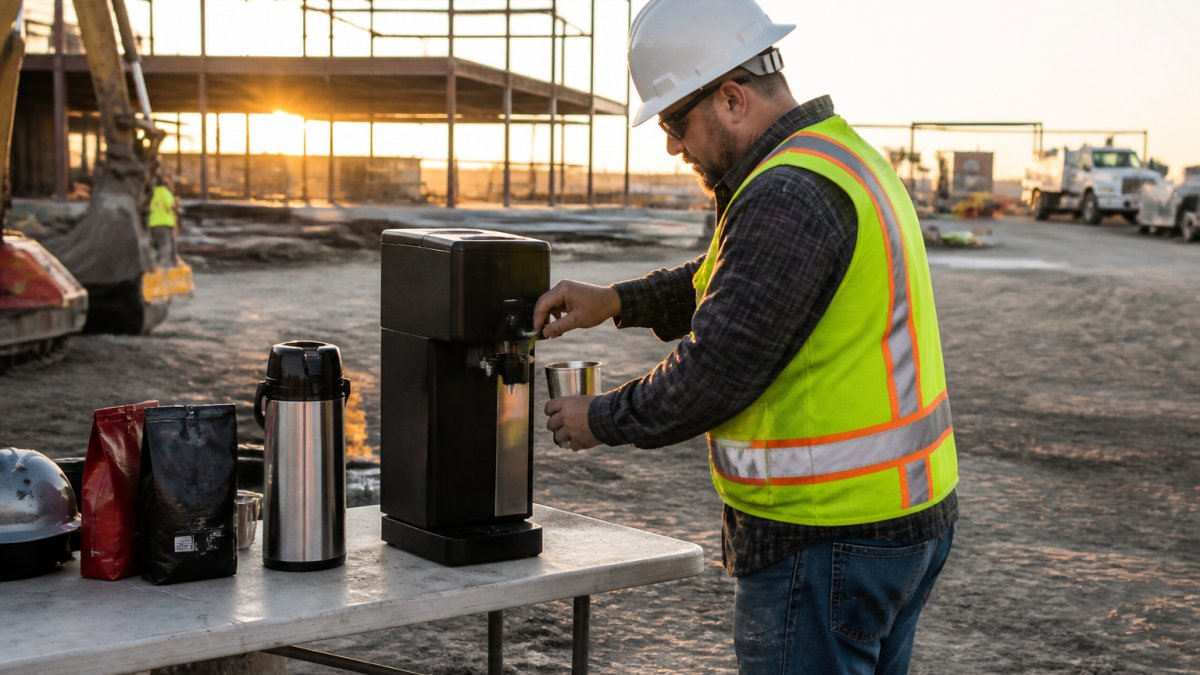
For a bigger crew, the Better Chef programmable 12-cup coffee maker handles a full pot at once. For a small crew or a single trailer, the 5-cup coffee maker with scoop keeps things simple.
Bulk Coffee for Construction Sites: Supplier and Packaging Options
When considering coffee for a construction site, think about how the crew brews and how often you can restock.
Packaging Formats: Trade-Offs by Crew Size and Site Conditions
- Whole bean or ground bags deliver the best flavor and lowest cost per cup. They suit sites with a dedicated brewer and a secure storage spot. Ground coffee is easier on site, no grinder needed, but stales faster once opened. Whole bean lasts longer but requires a grinder, which adds equipment and cleanup.
- Single-serve pods offer speed and no cleanup, making them ideal for sites with a Keurig-style brewer and crews that trickle in at different times. The trade-off is higher cost per cup and more packaging waste. Pods work best for crews of 10 or fewer or for sites where labor time is tight.
- Instant coffee is the smallest-crew and tightest-space solution. A 30-serving pouch covers a 5-person crew for several days and requires only a kettle. The trade-off is taste, but for a remote site with no power for a brewer, instant keeps the crew caffeinated.
Our 60-pack single-serve capsules work with any Keurig-style pod brewer.
Supplier Comparison: Wholesale, Local Delivery, Grocery, and Subscription
Here are supplier types construction-site buyers may consider:
| Supplier Type | Best For | Delivery Frequency | Cost Per Cup | Key Consideration |
|---|---|---|---|---|
| Wholesale/roaster direct | Large crews (20+), long projects | Weekly or biweekly | Lowest | Requires storage space and a minimum order |
| Local coffee delivery | Medium crews, urban sites | Weekly | Low-moderate | Limited to local roasters; check delivery area |
| Grocery/retail | Small crews, emergency top-ups | As needed | Moderate | Convenient but higher per-unit cost; limited bulk sizes |
| Subscription service | Consistent supply, remote sites | Monthly or biweekly | Moderate | Set-and-forget; watch for shipping costs and lead times |
Matching Supplier and Format to Your Site
A practical buying checklist for construction-site managers:
- Count the crew and shifts, use the consumption framework to estimate weekly volume.
- Confirm brewing equipment, pods require a pod brewer; ground coffee requires a brewer and filters; instant requires only a kettle.
- Check storage, whole bean and ground bags need airtight, secure storage; pods need dry space; instant is the most forgiving.
- Compare supplier lead times and minimums, match delivery frequency to your reorder threshold.
- Calculate total cost per cup, include consumables (cups, filters, creamer) and labor time for cleanup.
- Set a backup supply, one week of coffee stored separately from daily stock.
This framework addresses how to choose a supplier and format for a construction site, not just a kitchen.
Coffee Supplies for Construction Crews: The Full Checklist
Coffee supplies for construction crews go beyond the beans. Run through this list before the first shift:
- Coffee (bulk bags, pods, or instant)
- Brewer or kettle that fits site power
- Insulated thermos or travel mug
- Filters and scoops
- Cups, lids, and stirrers
- Creamer and sugar
- Sealed storage container
- Backup supply of at least one week
Keep the backup supply separate from the daily stock.
Storage and Freshness in Changing Site Conditions
Coffee goes stale fast when it sits in heat, damp, or open air. On a site, those conditions are everywhere. Store beans and grounds in an airtight container, away from direct sun and moisture.
Our 500ml stainless steel thermos is listed with thermal insulation performance of 6-12 hours.
Build Your Site Coffee Order With Blacktop Life Coffee Co.
Getting coffee right on a construction site is about matching the crew, the shift, and the conditions. Survey the workers, do the quantity math, pick gear that survives the job, and keep a backup on hand.
Blacktop Life Coffee Co. was founded by a long-haul truck driver and offers highway-inspired coffee sourced from sustainable farms. Start with our Breakfast Blend +, a medium roast with added Robusta for extra caffeine. Get started with Blacktop Life Coffee Co.
Frequently Asked Questions
How much coffee should I buy for a construction crew?
Estimate the amount your crew needs based on its size and shift schedule, and consider keeping a backup supply on hand.
Should a construction site buy whole-bean or ground coffee?
Choose a format based on your crew's preferences and available equipment.
How do you keep coffee hot on a construction site?
The Blacktop Life 500ml thermos is listed with thermal insulation performance of 6-12 hours.
Can coffee for construction workers be a business expense?
Ask your accountant whether coffee provided to employees on site is a business expense for your setup.
